Which history are we talking about?
There are two. The first, that of the origins, remains to be written: no verifiable source dates the kardoune, and we repeat neither “for centuries” nor “thousand-year-old tradition.” The article Kabyle kardoune: where does this Algerian ribbon come from reviews what is known about its origin and its name.
The second is more modest, but it can be followed: that of its visibility in the French-language press. It shows how a practice passed down in families became a public topic.
What do the press articles trace, from 2018 to 2024?
- April 9, 2018, RTBF. A test of three women with curly hair presents the kardoune as a woven cotton ribbon of Algerian origin. A tester of Kabyle Berber origin recounts the childhood evenings when her mother put it on her hair; none of the three ends up with straight hair[1].
- August 22, 2020, Le Tribunal du Net. The kardoune is presented as a “grandmother’s tip” originating in Kabylia, passed down from generation to generation and relayed on the internet. The article cites top hairdressers without naming any, and gives no scientific source[2].
- December 14, 2022, Algérie 360. A French content creator tests the kardoune for one night. Her verdict is mixed: less puffy hair, but not straightened enough for her taste[3].
- July 3, 2024, Consoglobe. The kardoune appears among heat-free straightening methods, with two alternatives: the pharmacy crepe bandage and the old pair of tights[4].
These four milestones do not form a complete timeline: they are the articles we were able to open and read. They nevertheless show a common thread, a practice presented as a heat-free method.
What do these articles say about transmission?
All of them stress the family nature of the practice: the grandmothers who straightened the hair of their families[2], the mother who put the ribbon on her daughters’ hair[1]. None gives a figure or a precise place. It is testimony, not a census: it is valuable for understanding the practice, but it does not allow a detailed history to be written.
From family practice to product: the Kardoune KARDZ
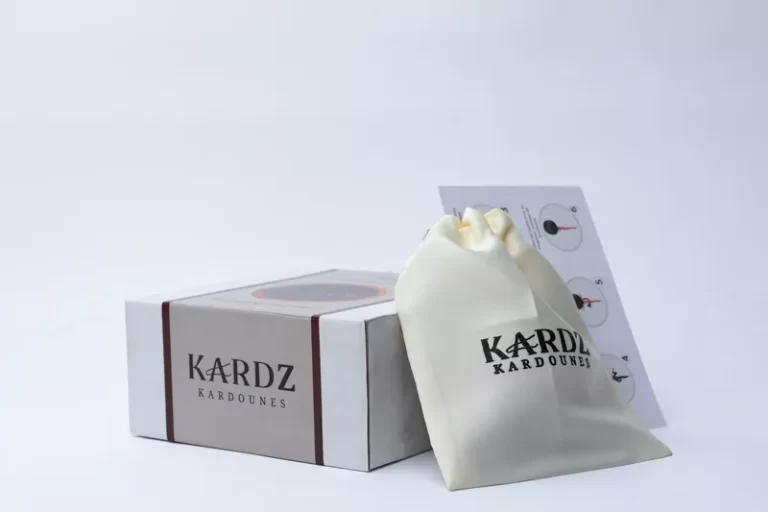
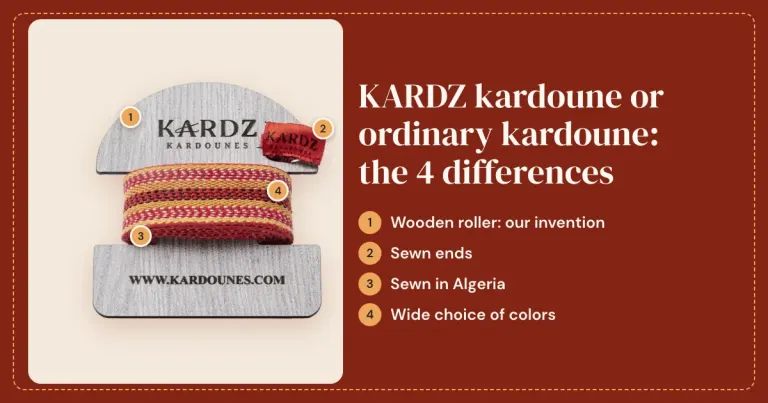
KARDZ, the brand that publishes this blog, says Kabylia is its land of origin, and ties its kardoune to a gesture passed down from mother to daughter. The KARDZ Kardoune is made in Algeria by its seamstresses; the brand added a wooden roller to store it without knots and illustrated instructions. These are the brand’s choices: they extend a gesture, they do not claim to reconstruct its history.
Why this renewed interest?
The articles do not explain it, and we found no study on the subject. They all present the kardoune from the same angle, that of heat-free straightening. To find out what this method allows, and what it does not, read Straightening your hair without heat and the guide The kardoune.
Frequently asked questions
Is the kardoune a very old tradition?
We cannot say so: no verifiable source dates it. Testimonials speak of a practice passed down in families, from generation to generation, without saying since when. We therefore do not repeat phrases such as “thousand-year-old tradition.”
When did the kardoune become known in France?
The French-language press mentions it from 2018 in the articles we were able to read, with trials in 2018 and 2022. We have no circulation figures, nor a precise date for the start of public interest.
What is the difference between the traditional kardoune and today’s?
The basic ribbon is the same: a narrow fabric that you wind around your hair. Some makers add accessories, such as KARDZ’s roller and illustrated instructions. No source describes in detail how the materials or patterns evolved.
Sources and further reading
- Walravens F., “Lisser ses cheveux sans chaleur ? On a testé le kardoune et le plaquage mexicain,” RTBF Actus, April 9, 2018 (in French). rtbf.be/article/lisser-ses-cheveux-sans-chaleur-on-a-teste-le-kardoune-et-le-plaquage-mexicain-9887393
- Wuylens J., “Se lisser les cheveux sans chaleur ? Voici une astuce de grand-mère infaillible,” Le Tribunal du Net, August 22, 2020 (in French). letribunaldunet.fr/astuces/se-lisser-les-cheveux-sans-chaleur-voici-une-astuce-de-grand-mere-infaillible
- Algérie 360, “Une « influenceuse » française teste et approuve le kardoune algérien,” December 14, 2022 (in French). algerie360.com/une-influenceuse-francaise-teste-le-kardoune-algerien
- Petit P., “Comment lisser ses cheveux naturellement ?”, Consoglobe, July 3, 2024 (in French). consoglobe.com/?p=341545