What do you need before you begin?
Prepare a kardoune long enough for your hair, a hair tie, a brush or comb, and a serum or cream for the lengths. If you hesitate on length, the article Choosing your kardoune size explains how to choose it. Plan for the evening: it is the recommended time, after your hair care, to keep the ribbon on overnight.
What are the six steps?
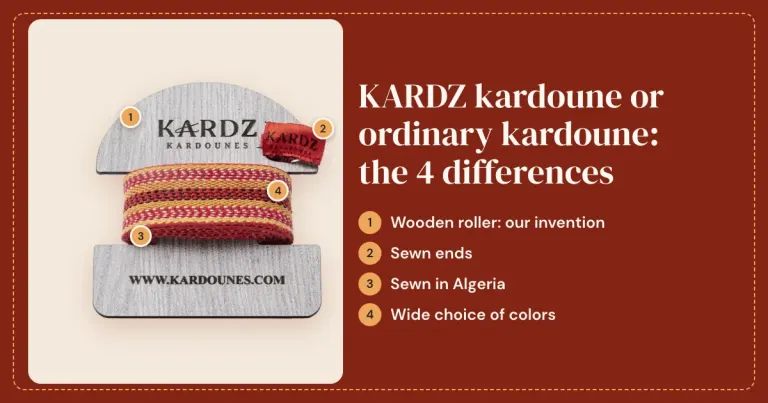
These six steps are those of the illustrated instruction leaflet of the Kardoune KARDZ, which you can see in the image above. Each is followed by a practical tip.
Step 1: comb your hair
Detangle it gently from root to tips. Well-detangled hair winds more evenly, without knots trapped under the ribbon.
Step 2: apply a serum or cream
The leaflet calls for a serum or a cream. The published trials vary: RTBF tested on wet hair[1], a content creator brushed dry hair before adding a care product[2]. Follow the leaflet and keep the hair barely damp at most: water makes the hair swell, and combing wet hair causes longer breaks than on dry hair[3].
Step 3: tie your hair in a low ponytail with a hair tie
The leaflet calls for a low ponytail. The hair tie should not be tighter than necessary: its only role is to gather the hair before winding.
Step 4: wind the kardoune all the way down, tightening it well
Hold the end of the ribbon between your teeth or under your chin, then wind it around the ponytail, from the base toward the tips, with even turns. “Tighten well” means firmly, not to the edge of pain: RTBF advises tightening firmly, but not too much at the base, to avoid marks[1].
Step 5: wind it again, from bottom to top
Go back up, covering the first turns, to the top of the ponytail. The turns stay even and flat: a ribbon that twists or piles up forms bumps that are uncomfortable for sleeping.
Step 6: tie a knot with the remaining length
Finish with a knot using the end of ribbon that remains. If there is almost none left, the kardoune is probably a bit short for your hair; if there is a lot left, you can tighten the turns more without pulling, or take a shorter one next time.
Do not pull on the roots
A kardoune should hold the strands, not pull on the scalp. Repeated traction is a known factor in traction alopecia: the risk increases with the intensity of the traction and its duration[4]. If you feel tension, pain or tingling, loosen or take off the kardoune. The guide Sleeping with a kardoune details these precautions.
How long does it take to put on?
The RTBF trial counts about four to five minutes for the winding[1]. At first, it often takes longer: the content creator cited above had to redo the winding several times before getting the result she was after[2]. The technique gets faster with practice.
What should you do on waking?
Undo the knot, unroll the ribbon without pulling, then style your hair again. Then wind the kardoune onto its roller: stored this way, it does not tangle and is ready for the next evening. If you need to wash it, see How to care for your kardoune.
What mistakes should you avoid?
- Winding too tightly to be sure the ribbon holds: better a firm, even winding, checked by moving your head.
- Winding soaking-wet hair: leave it barely damp.
- Taking a kardoune that is too short: the last strands stay loose and the final knot becomes impossible.
- Storing the ribbon loose: it tangles, and putting it on the next day becomes a chore.
- Expecting the result of a flat iron: the kardoune softens and relaxes, it does not make hair straight.
Frequently asked questions
Should you wet your hair before putting on a kardoune?
The leaflet says to comb and then apply a serum or a cream, without mentioning wetting. The press trials vary: wet hair for RTBF, dry hair for a content creator. If you dampen your hair, keep it barely damp.
Why does my kardoune slip during the night?
The most likely causes are turns spaced too far apart, a twisted ribbon or insufficient length. Redo the winding with even turns and, if the final knot is impossible, try a longer kardoune. Avoid compensating by tightening more.
Can you put on a kardoune without help?
Yes, with a little practice. Holding the end between your teeth or under your chin frees both hands. The first time, allow time: several tries are normal, as one tester found when she had to start over.
Is the kardoune suitable for all hair?
You need hair long enough for a low ponytail and then winding. The effect varies with the texture and is more subtle on tight curls. See the guide on hair types before choosing a length.
Sources and further reading
- Walravens F., “Lisser ses cheveux sans chaleur ? On a testé le kardoune et le plaquage mexicain,” RTBF Actus, April 9, 2018 (in French). rtbf.be/article/lisser-ses-cheveux-sans-chaleur-on-a-teste-le-kardoune-et-le-plaquage-mexicain-9887393
- Algérie 360, “Une « influenceuse » française teste et approuve le kardoune algérien,” December 14, 2022 (in French). algerie360.com/une-influenceuse-francaise-teste-le-kardoune-algerien
- Gavazzoni Dias M. F. R., “Hair cosmetics: an overview,” International Journal of Trichology, vol. 7, no. 1, 2015, pp. 2-15. doi.org/10.4103/0974-7753.153450
- Billero V., Miteva M., “Traction alopecia: the root of the problem,” Clinical, Cosmetic and Investigational Dermatology, vol. 11, 2018, pp. 149-159. doi.org/10.2147/CCID.S137296